
Account & Billing
All utility bills are due on the 28th of the month. If the due date is a weekend or holiday, the due date is the next business day.
Stoughton Utilities provides the electric, water, and wastewater service to customers in the City of Stoughton. We also provide electric service to customers in the surrounding rural areas.
We read meters on the 1st of the month so we can calculate an accurate billing statement. Bills are mailed out monthly on the 8th, or the following business day if the 8th falls on a weekend or holiday.
If you’re a new customer, your first bill will be mailed out on the 8th of the month following when your service started unless your account has only been active for 5 days or less. For example, if you sign up for service effective January 1, your first bill will be mailed out on February 8. If you sign up for service effective January 28, your first bill won’t be mailed out until March 8.
The Power Cost Adjustment Clause (PCAC) is the monthly charge or credit that reflects the difference between our electric rates and the actual wholesale cost of power.
The state of Wisconsin requires all utilities to collect $16.00 per customer per year to provide both energy conservation and income-based assistance. Half of the money collected is designated for energy conservation and the other half is for low-income assistance.
To start, stop, or transfer service to a new Stoughton address, please complete our online service application. You will need a valid photo ID to start new service.
You can also complete a service application in our office during normal business hours.
Utility bills can fluctuate based on a number of factors including weather changes, wholesale power costs, water leaks, and more. Air conditioning and electric heat like space heaters are typically the largest electric users in a home, and wholesale power costs can increase due to higher fuel costs. A frequent cause of high water usage is running toilets or other leaks. Please contact us and we can help you determine the likely cause of utility bill changes based on your individual circumstances.
Once you receive your first utility bill, you can enroll in MyAccount to view your account online, update your preferences, compare your usage, and more. To enroll, you will need your utility account number and the name of the primary utility account holder exactly as it is shown on your utility bill. Contact us if you have questions or need assistance.
Contact our office to add another adult to your utility account at (608) 873-3379 or customerservice@stoughtonutilities.com.
Electric
No, Stoughton Utilities does not cut down customer trees, and the homeowner is responsible for hiring a contractor to take down any trees on their property. We will work with you and/or your contractor to move or de-energize any powerlines to the tree can be removed safely.
Stoughton Utilities will typically only trim tree limbs that are touching the powerlines.
To report a power outage, please call our 24-hour emergency line at (608) 873-9322 to have our on-call staff dispatched. Please be patient, as call volumes are often high during outages. Crews will work to get power restored as quickly and safely as possible. Click here for more information.
Stoughton Utilities is responsible for the electric service up to where it connects to the customer-side service, as well as the electric meter itself. Homeowners are responsible for the mast/conduit attached to their home and the meter box.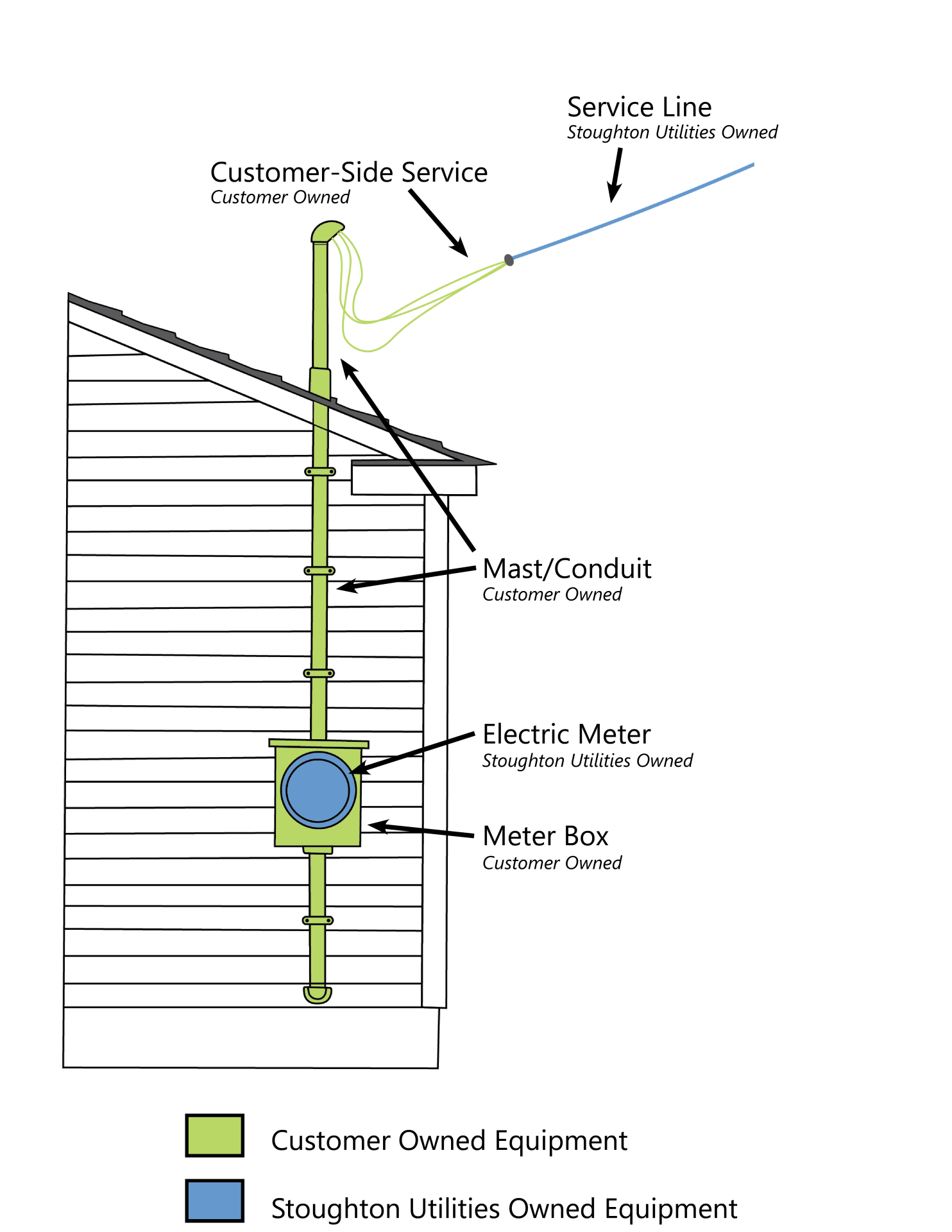
If you see a downed power line, stay as far away as possible and call 9-1-1 immediately. They will contact our on-call staff to have the area made safe. Keep others away from the power line if possible until emergency responders can arrive.
Heating and cooling systems typically account for roughly 30-50% of total energy consumption (electric baseboard heat, space heaters, air conditioners, etc.). Electric water heaters, refrigerators and freezers, washers and dryers, lighting, and other electronics can all use substantial amounts of electricity as well. Older appliances typically use more electricity as they aren’t as efficient as new models, and things like air conditioners should be maintained regularly to keep them running as efficiently as possible.
Wastewater
The property owner is responsible for the sewer line from the sewer main in the street to the house. If you have a sewer backup or clog, our operators can come out and see if there is a clog in the sewer main that could be causing the backup. We are not able to clean or televise a customers private sewer lateral, and property owners will need to hire a private contractor if the issue is not in the publicly owned sewer main.
Sewer backups can be caused by tree roots growing into the sewer laterals, or things being flushed that don’t break down in the sewer system like “flushable” wipes, paper towels, sanitary products, grease, and oil. Click here for more information on items that should never be flushed down toilets or put down sink drains into the sewer system.
Stoughton has a sanitary sewer system for things that are flushed down the toilet and washed down sink drains, and a storm sewer system that carries rainwater and runoff from the street to prevent flooding. The sanitary sewer system goes directly to the Stoughton Wastewater Treatment Plant, where it can be treated before it is released back into the environment. Rainwater going into the storm sewer doesn’t need to be treated at the wastewater treatment plant, and is instead released back into the environment right away.
Rain water and discharge from sump pumps, called clear water, should never be discharged into the sanitary sewer as it can overwhelm the system and treatment plant, leading to damaged equipment and overflows.
Stoughton Utilities owns and maintains the sewer mains in the street only. Sewer laterals, going from the sewer main in the street to your home, are the homeowners responsibility. Learn more about your sewer lateral here. 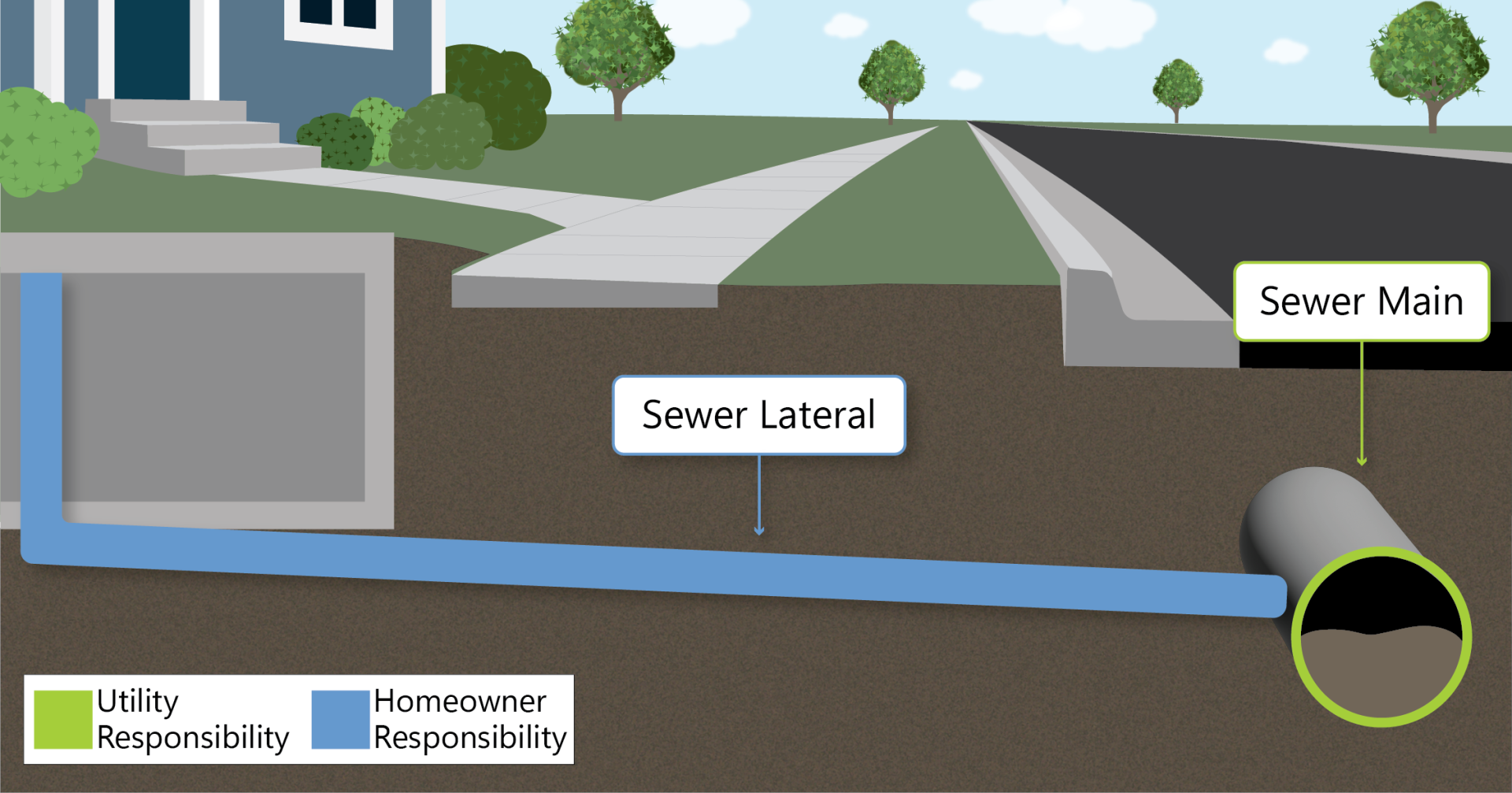
Wastewater charges are based on the amount of water measured by your meter. This means that all water used, including water used outdoors for lawns, gardens, or other purposes, is also subject to wastewater charges.
Customers who regularly use water outdoors may choose to have a separate water-only meter installed. This meter must be plumbed so that it measures only water used outside. Installation requires plumbing work by a certified plumber and will involve additional costs and customer charges. You can find more information in our policies here.
Water
Stoughton’s tap water meets all safety standards set by the Wisconsin Department of Natural Resources (DNR) and the United States Environmental Protection Agency (EPA). You can find our most recent Drinking Water Quality Report here.
Stoughton’s drinking water comes from the Mt. Simon aquifer, a groundwater source deep below the surface. Four wells located throughout the city pump this water from the ground and into our water distribution system. More than 78 miles of water mains and two water towers work together to reliably deliver water throughout the community.
Rust and sediment is always present at the bottom of water mains, and regularly mixes with drinking water in microscopic amounts. Certain events can stir up the sediment in the water mains, causing discoloration. Water main breaks, water main replacement projects, fire fighting efforts with high water use, or other disturbances that cause a significant change in water flow can result in temporary discoloration. Water discoloration can also occur in areas of low water flow, such as cul-de-sacs and dead-end roads. Stoughton Utilities regularly flushes our hydrants to clear out much of the sediment that settles on the bottom of the water mains.
You can flush the discolored water from your pipes by running the cold water from the lowest point in your house for 5-10 minutes until the water runs clear again.
Stoughton’s water is 18.0 grains of hardness.
The average iron content in our water supply is 0.17 parts per million (ppm). This amount will vary between 0.00 ppm and 0.26 ppm based on your location within the city.
The PH level of the water supply ranges from 7.4 – 8.5.
Stoughton Utilities disinfects our water with chlorine, which is a step in the water treatment and distribution process to assure the biological safety of water. We add different amounts of chlorine throughout the year to help combat possible contaminants that may become problematic in water with the elevated temperatures.
Stoughton Utilities fluoridates the water that leaves our wells. Fluoridated water keeps teeth strong and reduces cavities by about 25% in children and adults.
Community water fluoridation is recommended by nearly all public health, medical, and dental organizations. It is recommended by the American Dental Association, American Academy of Pediatrics, US Centers for Disease Control and Prevention, US Public Health Service, and World Health Organization.
Stoughton Utilities voluntarily began disinfecting water at all three of our production wells in 1980. Disinfection now occurs at all four of our production wells as a requirement of state and federal regulatory agencies. It is important to emphasize that the disinfectant we use is commonly used throughout the water industry and our use is strictly monitored and poses no health risks. Trace amounts of this disinfectant are typically unnoticeable, but all of our senses are different. If you are able to notice the taste in the public water supply, you can place the drinking water in a pitcher, as the disinfectant will volatilize and leave the drinking water in short time.
Lead is unusual among drinking water contaminants; it seldom occurs naturally in water supplies like rivers and lakes. Lead enters drinking water primarily as a result of the corrosion, or wearing away, of materials containing lead in the water distribution system and household plumbing. Stoughton Utilities tests our water regularly for numerous water contaminants, including lead. In 2021, Stoughton Utilities completed a Lead Service Line Replacement Project, replacing 100% of the known lead services in the community.
You can find more information on lead here.
If you would like your home’s water tested, you can call the Wisconsin State Laboratory of Hygiene at (800) 442-4618 and request a test kit. Additional certified laboratory testing options can be found using a list published by the Wisconsin Department of Natural Resources. All costs associated with testing are the responsibility of the homeowner.
Stoughton Utilities maintains the water mains in the street, the water service lateral from the water main to the curb stop, and the water meter. Property owners own and maintain the water service line from the curb stop into the house and the shutoff valves before and after the water meter.
Click here for more information.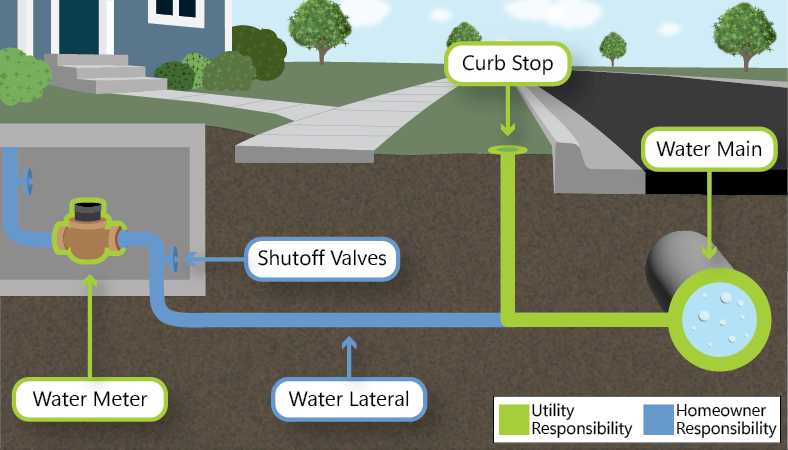
The most common causes of water leaks in a home are dripping faucets, leaking valves, and worn toilet flappers. You can easily check for leaks around faucets and valves by visually inspecting them to ensure they are dry and there is no water pooling underneath them.
Check to see if your toilet is leaking by putting a few drops of food coloring into the tank at the back of the toilet. Let it sit for 10 minutes, and then look in the bowl of the toilet. If any of the food coloring shows up in the bowl, you likely need to replace your toilet flapper.
Click here for more information on finding and fixing water leaks.
The average person uses approximately 2,000 – 3,000 gallons of water per month. It’s important to review your utility bill every month so you know your average monthly usage and can see if it increases unexpectedly. Your water use can fluctuate based on your habits and the seasons. It’s also not uncommon to notice a change of 1,000 gallons every other month or so, since we only bill in 1,000 gallon increments.