
Your water service connection includes several components that work together to deliver safe, reliable drinking water to your home or business. Some of these components are maintained by the utility, while others are the responsibility of the property owner. Knowing who is responsible for each part of the system, how your water meter records usage, and how that usage translates to your monthly bill can help you better understand and manage your water service.
Water System Responsibility
Stoughton Utilities maintains the public water system that delivers safe, reliable drinking water to homes and businesses throughout the City of Stoughton. We own and maintain over 78 miles of water main, 4 wells, 2 water towers, and over 5,400 water meters. While Stoughton Utilities is responsible for maintaining much of the public water system, there are important parts of your water service that are the property owner’s responsibility.
Stoughton Utilities Responsibility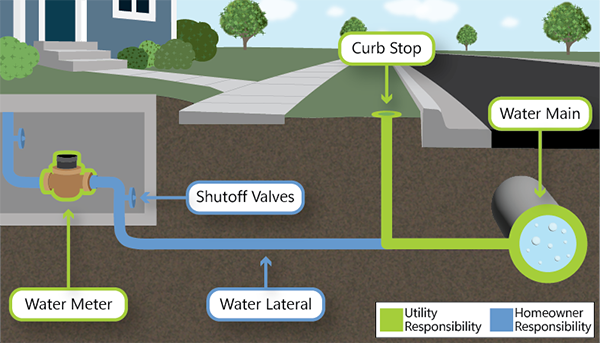
Stoughton Utilities owns and maintains the water mains and laterals up to and including the curb stop, typically located in the park row. SU also owns and maintains the water meter.
Property Owner Responsibility
Individual property owners are responsible for all water laterals, valves, and pipes after the curb stop. This includes the shutoff valves located before and after the water meter. Click here for more information about maintaining your shutoff valves.
Your Water Meter
Your water meter is used to measure the amount of water that goes into your home. It is typically located in the basement by the wall closest to where the water comes into the house, or in a utility room. As water passes through the meter, the counter on the meter goes up.
Your water meter is equipped with an encoder receiver transmitter (ERT) that sends the current meter reading to us remotely via radio signal. Stoughton Utilities staff drive through the city once a month with special equipment that picks up these radio signals so we can calculate your monthly utility bill.
Zero Water Readings
Occasionally, the ERT will stop sending a signal to us when we do our monthly readings. When this happens, the meter is still measuring your monthly usage, but our equipment doesn’t receive the reading. As a result, your monthly billing statement will show zero water usage.
After a few months of continuous zero water usage, our staff may reach out to you to schedule a time for us to change out your meter. We will get the actual water usage reading directly from the meter, and you will be charged for all of the water used (and the corresponding wastewater charges) while the ERT wasn’t working. This is why it’s important to always review your monthly utility bill for accuracy. If you notice that you have not been billed for any water usage and you believe that is incorrect, please contact us so we can schedule a time to replace your water meter at no cost to you.
Leak Detection
Your water meter also has a built-in leak detector. If your water use seems unusually high, turn off all water in your home and make sure no appliances are running. Open the meter cover and check the red circular dial near the center. If it’s spinning, water is flowing through the meter and you may have an internal plumbing leak.
Click here for more information on finding and fixing water leaks.
Water Billing
Stoughton Utilities meter technicians drive through the city every month, usually on the 1st of the month, with special equipment that receives a radio signal from your water meter. This signal tells us the current water usage reading on your water meter so we can accurately calculate your utility bill.
Understanding Your Water Bill
Your water meter measures your usage exactly, however, we only charge you per 1,000 gallons of water used. For example, if you used 1,500 gallons of water in a month, you will only be charged for 1,000 gallons of water. The additional 500 gallons of water will roll over to the next month. This is why your billed water usage can change month to month, even if your usage habits have stayed the same.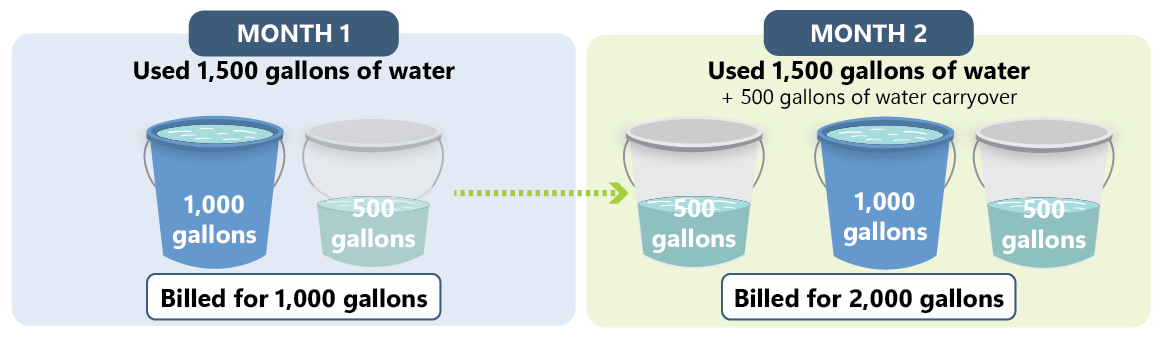
Every month, all water customers will see a Customer Charge on their utility bill. This is the minimum monthly charge for having water service to your home or business, and covers a portion of the costs for water meters, meter reading, and billing. You will receive this charge every month, even if you didn’t have any water usage.
Underneath the customer charge, you will also see the volume charge for the amount of water you used, and a charge for public fire protection. Public fire protection is a charge to each water customer for the maintenance of fire hydrants throughout the city.
On the back of your utility bill, you can find specific reading information about your water meter, including the read dates, weather the meter was read or estimated, and the actual readings from your meter.
You can find more information about how to read your utility bill here.
Water Rates
Just as the quality of your drinking water is closely monitored, water rates are also strictly regulated by the Public Service Commission of Wisconsin (PSC) to ensure utilities can deliver safe, reliable, environmentally responsible, and affordable water service over the long term. Stoughton Utilities must receive PSC approval before making any changes to water rates by first filing a rate review application. All rate reviews require a public notice, and some rate reviews also require a public hearing conducted by the PSC.
Water rates are designed to cover the full cost of providing reliable, safe, and environmentally responsible water service to the community. These costs include maintaining and operating wells, pumps, water towers, meters, and other infrastructure, as well as replacing aging components like water mains to reduce the risk of breaks and provide resiliency for the future. Rates also cover administrative expenses such as water testing, billing, collections, and required reporting. In addition, water rates fund a payment in lieu of taxes (PILOT) to the City of Stoughton and include a fair rate of return to support long-term system reliability.